Liberia’s "Citizenship Debate" is also a technology problem!
As Liberia debates citizenship reform, the bigger technology question is this: do we have the digital systems to protect jobs, verify skills, track work permits, and make fair decisions for Liberians?
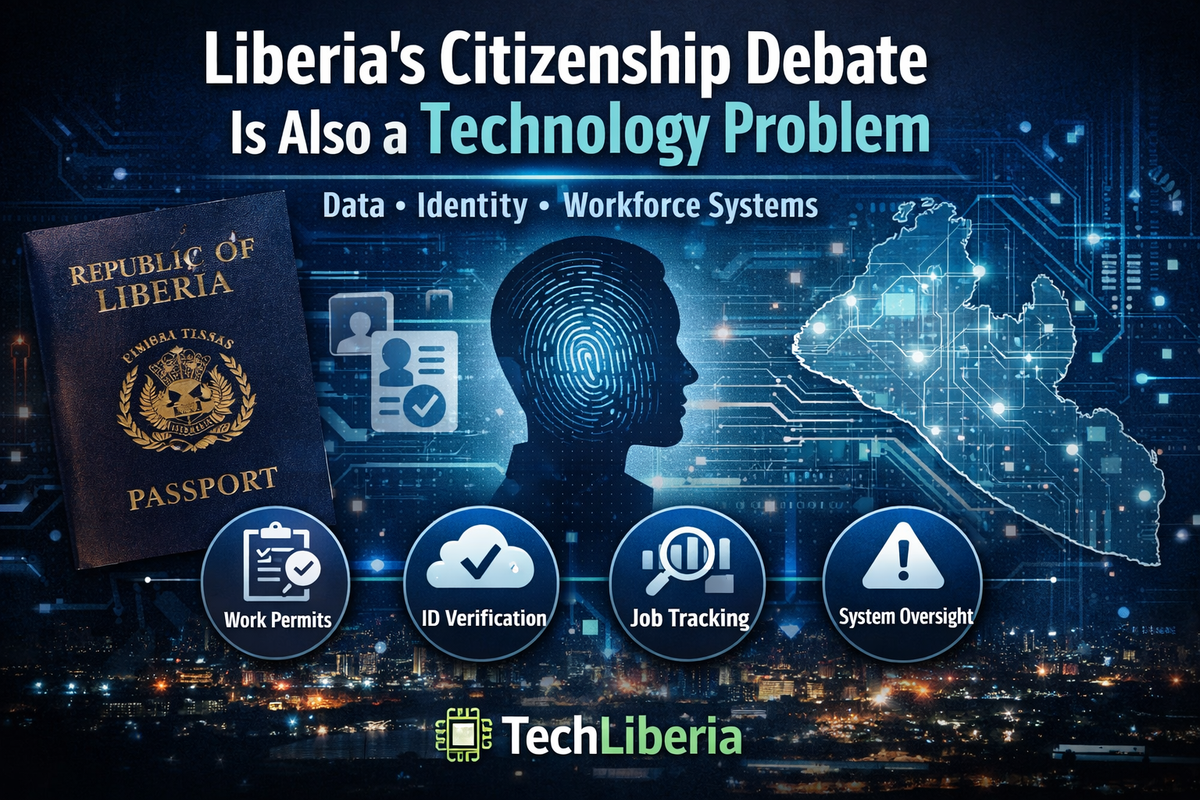
Former President Ellen Johnson Sirleaf’s recent call to revisit Article 27(b) has reopened a national conversation. But beyond politics, this issue exposes a deeper systems gap in Liberia: weak labor data, weak identity controls, and weak workforce visibility.
Liberia’s Constitution still says that only persons who are “Negroes or of Negro descent” qualify for citizenship by birth or naturalization, and Sirleaf has urged lawmakers to review that clause. At the same time, Liberia’s labor framework says foreign workers should not be hired where suitably qualified Liberians are available. That means the real national challenge is no longer just who can become a citizen. It is also whether Liberia can digitally govern who works where, under what permit, with what skills, and with what accountability.
From a technology perspective, this is really an identity and access management problem at country scale. In cybersecurity, organizations do not just hand out system access because someone asks for it. They verify identity, validate need, apply rules, log activity, and review exceptions. Liberia should think about citizenship, work permits, and labor protection in a similar way. Not as emotion first, but as governance architecture. A nation needs strong controls for who enters the labor market, who gets privileges, who fills sensitive roles, and whether the process can be audited. This is an analytical framing based on how modern digital governance systems work.
The labor data already shows why this matters. A 2025 report submitted to the Liberian Senate on work permits issued in 2024 said 10,103 work permits were issued to foreign nationals. The same report states that Indians accounted for the largest share and that 7,032 permits were issued for jobs, which it says are reserved for Liberians. It also found that for frequently occurring roles in its dataset, there were no positions that could only be fulfilled by permit recipients. That is not just a labor issue. That is a data governance warning sign.
When a country cannot clearly prove which jobs truly require foreign expertise and which jobs qualified locals can do, the failure is partly technological. It means the state likely lacks a trusted digital workflow for labor-market verification. A strong system would connect job descriptions, vacancy postings, applicant pools, permit applications, qualification checks, employer history, and inspection results into one auditable chain. Without that, decisions can become manual, inconsistent, delayed, or vulnerable to abuse. The Liberian Investigator recently reported that lawmakers are pressing for empirical data on whether Liberia’s foreign labor safeguards are actually being enforced.
This is why TechLiberia believes the smarter national question is not simply, “Should citizenship expand?” The smarter question is: “Can Liberia build the digital public infrastructure needed to manage citizenship, work authorization, and labor fairness before expanding the system?” A weak manual system becomes even riskier when the number of applicants, categories, and disputes grows. In tech language, Liberia may be debating a major policy upgrade without first hardening the backend. This last sentence is an inference from the governance and labor data now in public view.
What should be Liberia’s priorities right now?
1. Liberia needs a national labor intelligence platform. This should not just be a website with forms. It should be a real data system that tracks labor demand, skill shortages, permit requests, company hiring behavior, and geographic workforce gaps. The 2025 Senate report itself recommends developing and mandating a comprehensive national job portal, along with stronger audits and oversight. That recommendation points in exactly the right direction.
2. Liberia needs a digital employer accountability layer. Any company seeking to hire a foreign worker should have to demonstrate, in a verifiable system, that the position was advertised, Liberians were considered, and no suitably qualified local candidate was available. That is already consistent with the principle in the Decent Work Act highlighted by recent reporting and the Senate analysis. The problem appears to be less about whether the rule exists and more about whether the state can monitor and enforce it reliably.
3. Liberia needs a skills registry and training pipeline map. One reason companies often say they cannot find trusted local talent is that the country may not have a centralized, trusted way to match employers with verified Liberian skills. A national platform that links TVET institutions, universities, licensing bodies, and employers could help expose real skill gaps instead of allowing every employer to define gaps in private. The Senate report also recommends stronger collaboration with educational and training institutions and more capacity-building initiatives.
4. Liberia needs permit analytics and red-flag detection. In cybersecurity, we look for unusual patterns: repeated exceptions, abnormal access, concentration risk, or policy bypass. Liberia can do the same with work permits. If one company repeatedly hires foreigners into ordinary roles, or one sector shows a suspicious pattern of permits for jobs locals can do, the system should flag it automatically for inspection. That is how a country moves from paper compliance to operational control. This is a policy and technology recommendation based on standard monitoring logic and on the report’s recommendation for regular, transparent compliance audits.
5. Liberia needs digital transparency for public trust. Citizenship and foreign labor become politically explosive when people feel decisions are hidden. Public dashboards showing permit volumes, sectors, nationalities, job categories, approval reasons, and localization progress would help lower suspicion and improve accountability. Lawmakers recently complained they could not get adequate statistics to judge whether reforms were working. That alone shows Liberia needs better public-sector data systems.
This is where the citizenship debate becomes a true TechLiberia story. Liberia is not only arguing over identity in the legal sense. It is also confronting identity in the digital sense: who is verified, who is authorized, who is logged, who is prioritized, and who is protected by system design. Good national governance now depends on the same principles that protect modern networks: visibility, validation, audit trails, role-based controls, and continuous monitoring. This is an analytical interpretation, not a quote from any one source.
The lesson is simple. A country cannot run a 21st-century labor market with 20th-century data habits. Whether Liberia changes Article 27(b) or not, the country still needs better digital systems for labor protection, permit oversight, and workforce planning. If those systems remain weak, the fear many Liberians feel will not go away. But if Liberia builds strong digital governance around jobs, identity, and access, the country can have a smarter, calmer, and more evidence-based national conversation.