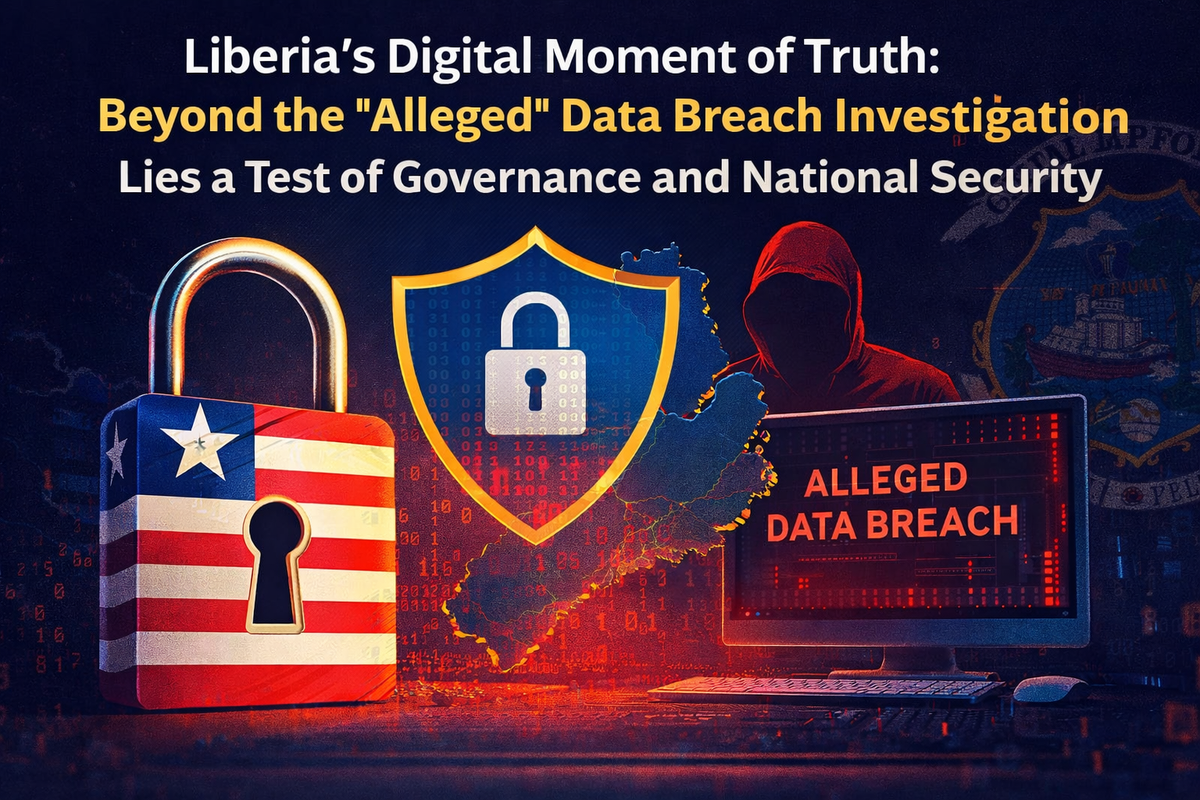
Liberia’s Digital Moment of Truth: beyond the “alleged” data breach investigation lies a test of governance and national security.
As lawmakers probe alleged breaches affecting critical institutions (LRA, LEC, & NIC), the real question is whether Liberia is institutionally prepared to secure its digital future.
When a country digitizes its tax systems, electricity services, investment records, and identity platforms, it is not merely installing technology. It is transferring public trust into databases, servers, and networks that most citizens will never see, but must rely on every day.
That trust must be protected.
Recent reports of alleged data breaches involving key government institutions (LRA, LEC & NIC) have triggered national concern. Whether the allegations are ultimately confirmed or not, this moment is bigger than one investigation. It is a test of our national readiness to respond to cyberattacks.
The real question is simple: Are we building our digital systems fast enough and securing them strongly enough? Because when digital systems fail, they do not fail quietly. They fail in ways that affect people’s money, privacy, and confidence in government.
If sensitive data such as tax records, electricity accounts, business registrations, or identity details were exposed, the consequences would not be theoretical. Criminals could exploit stolen information for fraud. Mobile money accounts could be targeted. SIM swap scams could increase. Businesses could lose confidence in the safety of national systems. International partners could question whether Liberia is ready for deeper digital integration.
For ordinary Liberians — market women, civil servants, students, and entrepreneurs — the result would be confusion, financial loss, and fear.
Liberia’s move toward digital services is necessary. We want faster revenue and tax processing, modern billing systems, streamlined business registration, and reliable identity verification. These are signs of progress. But progress without protection is vulnerability.
Cybersecurity is not an optional upgrade. It is a national security issue and an infrastructure concern. This is why the pending Cyber Act before our Legislature is so important. The proposed law is designed to strengthen cybersecurity governance, define responsibilities, and improve national coordination in responding to cyber incidents.
If properly enacted and enforced, it could establish clearer authority for national cybersecurity coordination, define obligations for protecting critical systems, strengthen response mechanisms during cyber incidents, and improve accountability across public institutions.
But a law on paper is not enough.
The real impact of the Cyber Act will depend on implementation. Will it include mandatory incident reporting timelines? Will it empower a national response team with real authority? Will it require minimum security standards for ministries, banks, telecom operators, and other critical sectors? Will it protect citizens’ data through enforceable safeguards? If these elements are strong and properly enforced, the Cyber Act could become a turning point in Liberia’s digital journey. If weak or poorly implemented, it risks becoming another law that exists without operational power.
No country can guarantee it will never face a cyber incident. Even the most advanced nations experience breaches. The true measure of digital maturity is not the absence of attacks — it is the strength of preparation and response. Without clear rules, incidents may be handled quietly. Silence allows threats to spread while Transparency builds trust.
Liberia’s digital transformation must now move into a second phase. The first phase focused on launching systems. The second phase must focus on securing and governing them. That means establishing minimum cybersecurity standards for Government entities and critical institutions, making breach reporting mandatory and time-bound, investing in disaster recovery to prevent prolonged outages, coordinating procurement to avoid fragmented systems, and enforcing data protection safeguards.
This moment should not become political. It should become structural.
If handled wisely, the current 2 million alleged data breach investigations, alongside the Cyber Act, can strengthen governance and national security, reassure citizens, and signal to investors that Liberia takes digital security seriously. If handled poorly, it risks eroding trust at a time when trust is essential.
Digital transformation builds efficiency. Digital security builds confidence. Liberia needs both. This is not simply about an alleged breach. It is about the foundation we are building — and whether that foundation is strong enough to protect the people it is meant to serve. What we do next will define whether we are merely digitizing government — or truly securing it.
=========================
About the Author
Marcus Blamoh is a Liberian cybersecurity and digital governance professional and founder of Valsal Information Security Group, a firm focused on cybersecurity advisory, risk assessments, regulatory compliance, and critical infrastructure protection. He has supported financial institutions, public-sector entities, and infrastructure operators in strengthening cybersecurity posture and governance frameworks. He writes in his personal capacity out of concern for Liberia’s digital transformation and the need to build secure and resilient national systems. Marcus holds four university degrees, including a Master’s degree in Cybersecurity, and is currently pursuing a PhD in Information Technology in the United States.