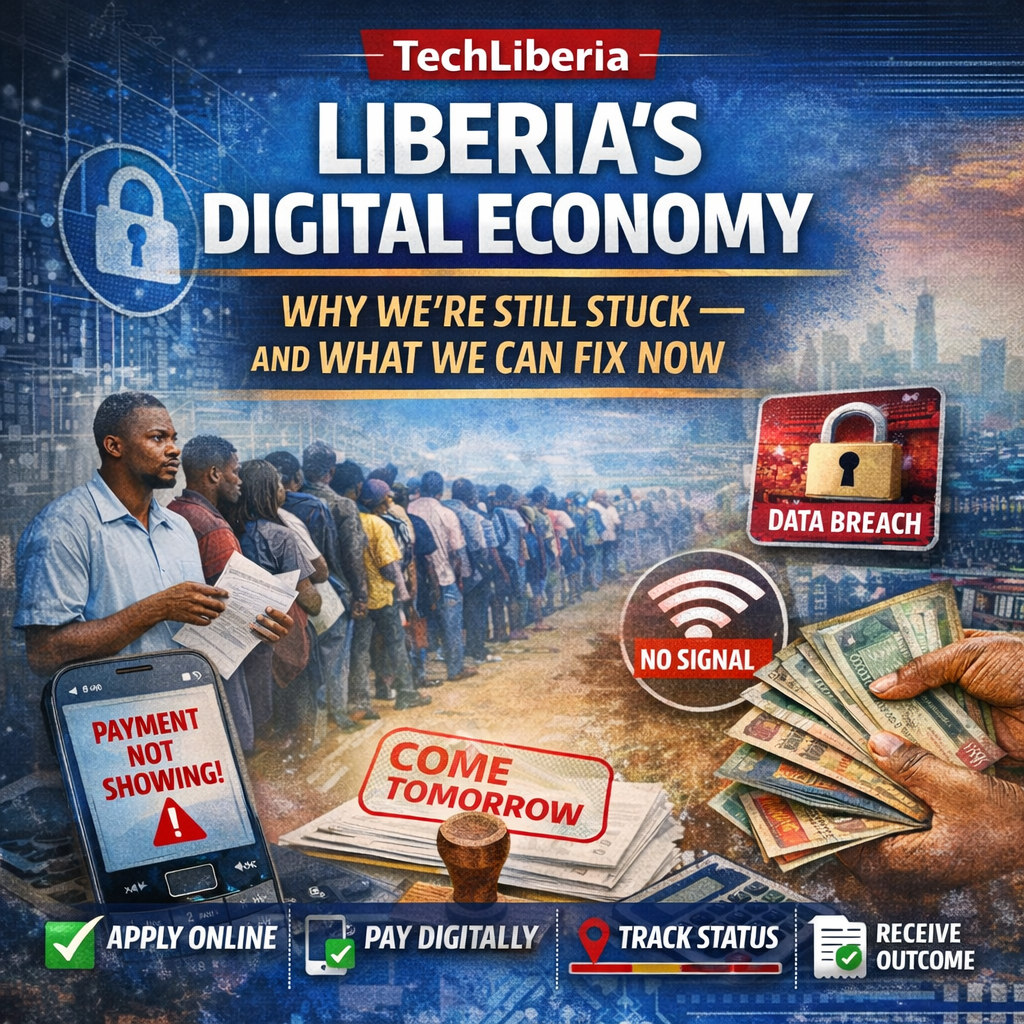
Liberia’s Digital Economy: why we’re still stuck — and what we can fix now?
A real digital economy is simple: it’s when technology reduces stress in daily life, so people can pay, apply, verify, and move forward without begging, walking around, or wasting time.
TechLiberia- Switching on Liberia’s Digital Future
Liberia is full of hustle. People work hard every day, selling, driving, studying, building small businesses, and trying to survive. So why does so much still feel slow?
Because in Liberia, too many important things still run on paper, cash, and “who you know.” That is not a digital economy. That is a manual economy wearing a digital shirt.
A real digital economy is simple: it’s when technology reduces stress in daily life, so people can pay, apply, verify, and move forward without begging, walking around, or wasting time.
So let’s talk truth: why we’re still stuck, and what we can fix now.
What “Digital Economy” Really Means?
A digital economy is not about everybody being online. It is about systems that make life easier:
- You can pay a fee and get a receipt instantly
- You can register a business without running around
- You can apply for services and track the status like a package
- Government can collect revenue with less leakage
- Banks pushing most of their services online
- Businesses can sell and receive payments faster
- Citizens can trust that systems are safe
In short, a digital economy is less friction, more trust, and more productivity.
Why We’re Still Stuck?
- We digitized forms, but not the full process: many services are “half digital.” You might fill something online, but the rest still depends on:
- printing paper
- going to an office
- meeting somebody
- coming back tomorrow
- the system is down
- the person is not here
Someone pays a fee and later hears: “Your payment is not showing.”
That sentence should not be normal. It usually means the system is not connected end-to-end. A real digital service must work like this: you apply, make a payment, track your transaction, and receive an outcome.
- Too much is still cash-only
Cash creates confusion and risk. Cash makes it hard to trace payments. Cash makes it easier for “small small” money to disappear. You pay for something and you don’t get a real receipt, or the receipt is handwritten and later disputed. That delays services and builds mistrust.
If Liberia wants a digital economy, then digital payment must become normal—not only for private businesses, but for government services too.
- Digital trust is low (scams + fear)
People are afraid of:
- mobile money scams
- fake SMS confirmations
- WhatsApp hacking
- SIM swap
- “my phone was hacked”
A market woman accepts mobile money but still checks her balance five times because she doesn’t fully trust the system. A business owner refuses online payment because someone close to him got scammed. This is why cybersecurity and consumer protection are not “extra.” They are part of development.
- Internet and electricity still block real growth
Digital tools need stable power and affordable connectivity. If data is expensive and the network drops, online business becomes stressful. A small business trying to sell online loses customers because they can’t respond quickly or reliably. You ran at the bank to withdraw money for an emergency, and the entire system is down. A digital economy cannot grow on weak foundations.
- Too many systems don’t connect
Different institutions collect the same information again and again. Platforms don’t share data. Everything becomes repetitive. You submit your details to one institution today, then another one asks for the same details tomorrow—because systems are not aligned. Disconnected systems create delays, and also create room for corruption.
What We Can Fix Now (Practical Wins Liberia Can Feel)
Liberia does not need 100 digital projects. Liberia needs a few high-impact fixes that reduce stress for ordinary people.
Here are three practical wins.
Fix #1: Digitize the Top 5 Daily Services that frustrate people most
Start with what people feel every day. Pick 5 high-traffic services and digitize them fully:
- apply online
- pay digitally
- track status
- receive outcome
- customer support when something goes wrong
Examples could include:
- business registration / renewals
- permits and licenses
- common government service fees
- student records/transcripts
- document verification services
Success looks like: fewer lines, less running around, less “come tomorrow.”
Fix #2: Make digital receipts the standard (especially for government fees)
Any time someone pays money for a government or private service, people should get:
- instant digital receipt
- reference number
- verification option (so anyone can confirm it’s real)
If a person pays and can verify the receipt instantly, disputes are reduced, and trust increases. That’s how leakages shrink.
Fix #3: Build digital trust (basic cybersecurity and accountability)
Liberia must protect key systems tied to:
- revenue
- electricity
- identity
- national services
At a minimum, institutions should have:
- multi-factor authentication for key accounts
- access controls and audit logs
- backups and recovery plans
- incident response plans
- staff training on phishing and basic cyber hygiene
And when incidents happen, the public needs clarity:
- what happened
- what was affected
- what is being done
- what will change
Trust is built with transparency and action, not silence.
Liberia’s Digital Economy Is a Choice
Liberia’s digital future will not happen by accident. It will happen when leadership chooses systems over speeches.
This is not about impressing people with “big big technology.” It is about making life easier for:
- the market woman
- the student
- the small business owner
- the public worker
- the ordinary citizen trying to get one service without stress
If Liberia focuses on practical wins, end-to-end services, digital payments with receipts, and cybersecurity standards, we will feel progress fast.
Liberia can build a digital economy. But first, we must stop doing half-digital work, and start building digital systems that actually work.